Explain the Different Forms of Efficient Market Hypothesis
However some information about events shaping the company may not be fully reflected in the price. They serve to explain the different forms wherein the theory is true.
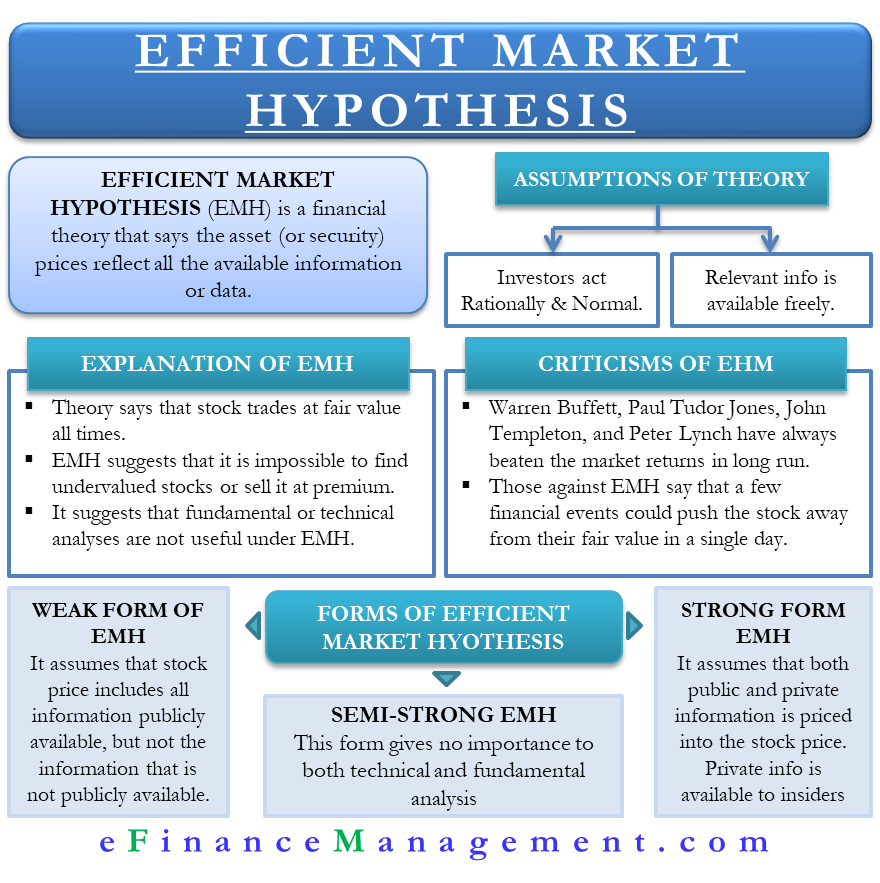
Efficient Market Hypothesis All You Need To Know
All publicly available information is reflected in the current market prices.

. Positives and Negatives of EMH. Weak semi-strong and strong. It additionally assumes that.
The following are the forms of EMH. The EMH considers three forms of market efficiency weak semi-strong and strong. Information or news in the EMH is defined as anything that may affect prices that is unknowable in the present and thus appears randomly in the future.
The Efficient Market Hypothesis is sometimes broken down even further by defining three types. In other words technical analysis of prices is of no use. This means that information contained in security prices and volume data are fully.
Market efficiency DOES NOT say that the price of an asset is its true price. Strong form of efficient market 3Semi-strong form of efficient market. Below we describe the three different forms of market efficiency and then discuss the implications of each form.
As a result it is impossible to ex-ante make money by trading assets in an efficient market. This differences occur from the notion of what is meant by the term all available information. Hence it would be useless to select which ones to buy or sell.
First individuals view market information differently. There are three different forms of the efficient market hypothesis. Investors trading on available information that is not priced into the market would earn abnormal returns defined.
Weak semi-strong and strong. The weak form of the EMH assumes that the prices of securities reflect all available public market information but may not reflect new information that is not yet publicly available. Though the efficient market hypothesisEMH as a whole theorizes that the market is generally efficient the theory is offered in three different versions.
EMH Efficient Market Hypothesis argues that no stock trades too cheaply or too expensively. The weak form EMH indicate that current asset prices reflect past price and volume information. A weak semi-strong and a strong version.
Eugene Fama classified market efficiency into three distinct forms. Weak semi-strong and strong How a trader or investor views efficient markets will completely depend on their view as to whether an individual or fund is able to beat the stock market. The Efficient Market Hypothesis EMH is an investment theory that states asset prices fully reflect all relevant and available information.
The following the three variants of EMH. There are three versions of the EMH. This states all past market prices and data are fully reflected in the price of securities and stocks.
Asset prices in an efficient market fully reflect all information available to market participants. An efficient market is one where all information is transmitted perfectly completely instantly and for no cost. Weak semi-strong and strong.
Three Types of Efficient market hypothesis. Three common types of market efficiency. Though the efficient market hypothesis theorizes the market is generally efficient the theory is offered in three different versions.
The three types are weak form EMH semi-strong form EMH and strong form EMH The types or forms are characterized by the degree to which EMH is applied. This is base-level EMH. 3 Forms of Efficient Market Hypothesis are.
Aspirin Count Theory. This form states that the stock prices indicate the public market information and the past performance has nothing to do with the future costs. The efficient market hypothesis says that the market exists in three types or forms.
The efficient market hypothesis states that it is not possible to consistently outperform the market by using any information that the market already knows except through luck. A market theory that states stock prices and aspirin production are inversely related. Each form is defined with respect to the available information that is reflected in prices.
This form states that the stock prices reflect both the market and non-market public information. There are three forms or degrees of the efficient market hypothesis. Proponents of the EMH argue that investors could benefit from the efficiency and attractive costs of passive investing where opponents of the theory believe stock prices could deviate from their intrinsic value.
Efficient market hypothesis was developed by fama in 1970. The weak-form EMH or weak efficient market hypothesis states that current security prices fully reflect all available security market data. Weak form of efficient market 2.
All past information like historical trading prices and volume data is reflected in the market prices. There are three serially higher ordered sets of available relevant information. The weak-form efficiency states that all historical information is already reflected in the current stock price.
Based on the information processing speed there are three forms of efficient market hypothesis weak semi-strong and strong form. Heres a little more about each. There are three variations of the hypothesis the weak semi-strong and strong forms which represent three different assumed levels of market efficiency.
The weak form of EMH says that you cannot predict future stock prices on the basis of past stock prices. The basic efficient market hypothesis posits that the market cannot be beaten because it incorporates all important determining information into curre. What are the 3 forms of market efficiency.
Eugene Fama developed a framework of market efficiency that laid out three forms of efficiency. The Weak Efficient Market Hypothesis suggests that current asset prices reflect all information on past prices. The Aspirin count theory is.
Problems with the idea of Efficient Markets cited by critics lie in the area of behavioral science.

Weak Form Efficient Market Hypothesis Prepnuggets
What Is The Efficient Market Hypothesis Emh Ig En

Efficient Market Hypothesis Emh Theory Definition And Types Of Forms

Efficient Market Hypothesis Definition Forms Assumptions
No comments for "Explain the Different Forms of Efficient Market Hypothesis"
Post a Comment